
2015 – MAY – SL
4.1 (IB 2015/MAY – SL 1/D)
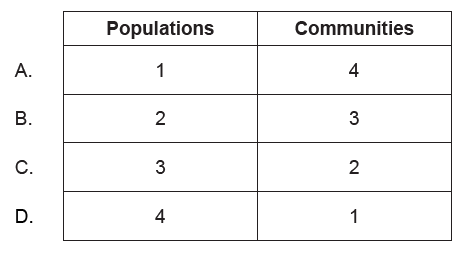
In a rock pool a student observes four different species of animal. She sees 43 flat periwinkles (Littorina littoralis), ten rough periwinkles (Littorina saxatilis), three shore crabs (Carcinus maenas) and one common goby (Pomatoschistus microps). How many populations and communities did she see in the pool?
4.1 (IB 2015/MAY – SL 1/C)
What is a principle of food webs?
A. All carnivores eat herbivores.
B. Plants are heterotrophs.
C. Primary consumers eat only plants.
D. Organisms can only occupy one trophic level.
4.2 (IB 2015/MAY – SL 1/C)
The diagram shows a pyramid of energy for a forest ecosystem.
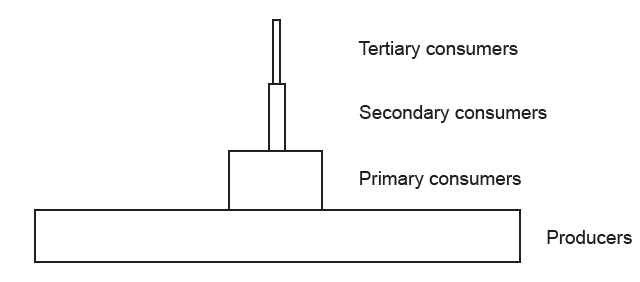
What conclusion can be drawn from the pyramid?
A. The number of organisms drops by 90 % in each trophic level.
B. Suitable units are Kgm−2 yr−1 .
C. The biggest energy loss is between producers and primary consumers.
D. The energy is recycled.
4.4 (IB 2015/MAY – SL 1/B)
What is the best definition of the greenhouse effect in the Earth’s atmosphere?
A. A naturally occurring effect by which shorter wavelength radiation is trapped
B. A naturally occurring effect by which longer wavelength radiation is trapped
C. An effect of pollution by which shorter wavelength radiation is trapped
D. An effect of pollution by which longer wavelength radiation is trapped
4.2 (IB 2015/MAY – SL 1/D)
The graph shows the growth of a population of rabbits inhabiting a new area.
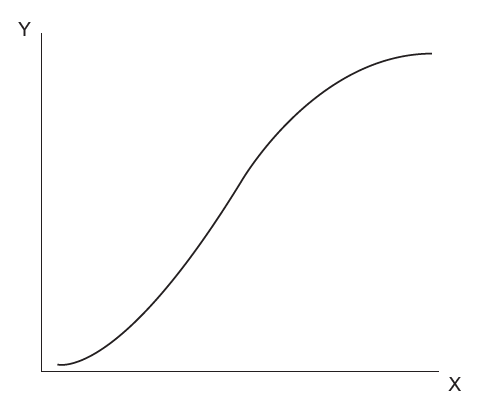
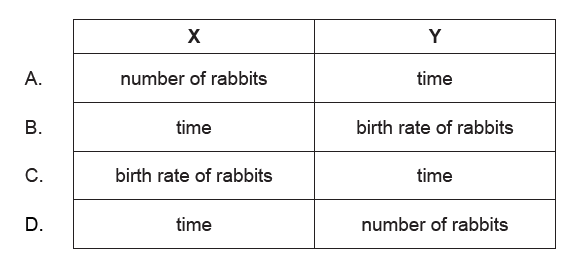
What would be suitable labels for the axes X and Y?
2014 – NOVEMBER
4.1 (IB 2014/NOV – SL 1/C)
What is the trophic level of the Leopard seal?
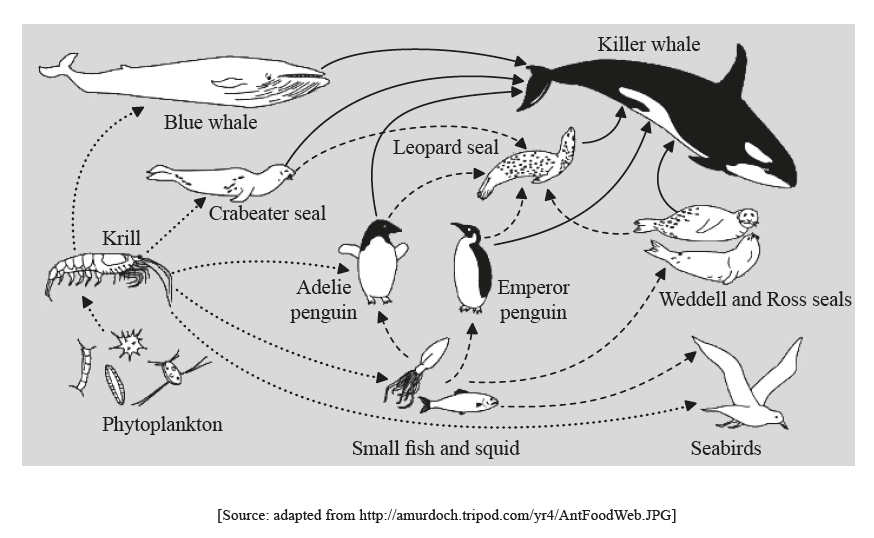
I. Secondary consumer
II. Tertiary consumer
III. Quaternary consumer
A. II only
B. III only
C. II and III only
D. I, II and III
4.3 (IB 2014/NOV – SL 1/C)
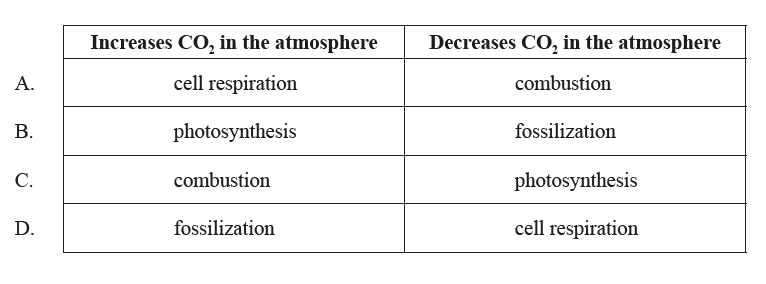
In the carbon cycle, which pair shows the correct change in atmospheric composition?
4.1 (IB 2014/NOV – SL 1/A)
In ecology, how is community defined?
A. Different species living and interacting with each other in a specific area.
B. Different families cooperating with each other.
C. A group of organisms of the same species who live in a specific area at the same time.
D. A specific area in which a group of species normally live.
2014 – MAY
4.1 (IB 2014/MAY – SL 1/D)
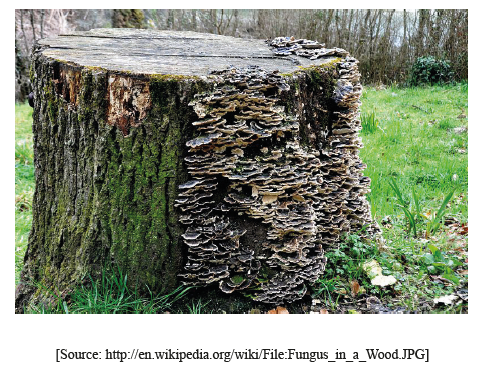
What type of organism is growing on the surface of this dead wood?
A. Autotroph
B. Primary consumer
C. Detritivore
D. Saprotroph
4.1 (IB 2014/MAY – SL 1/B)
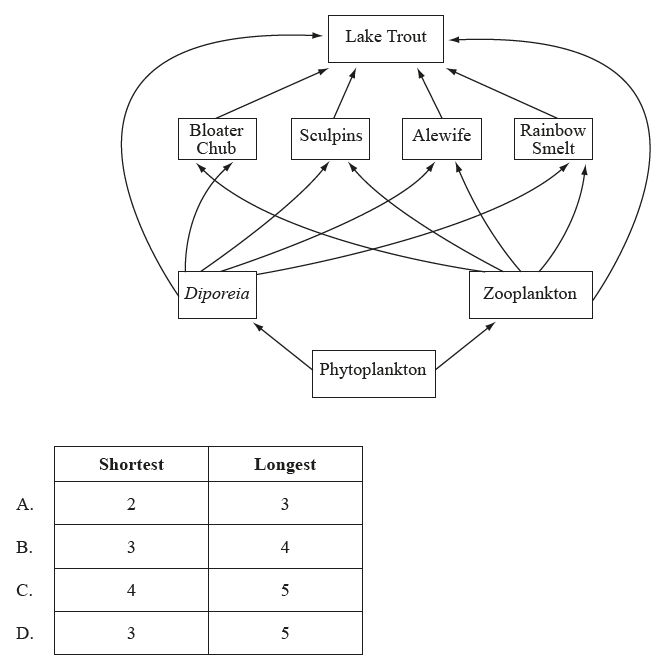
How many trophic levels are there in the shortest and longest food chains that end with Lake Trout?
4.4 (IB 2014/MAY – SL 1/A)
How does the precautionary principle affect the planning of public projects?
A. Supporters of any project must prove that it will not cause harm.
B. Opponents of any project must prove that it will cause harm.
C. Precautions must be taken to prevent harm to biodiversity during construction of the project.
D. Precautions must be taken to prevent harm to biodiversity after construction of the project.
4.4 (IB 2014/MAY – SL 1/B)
What might increase in arctic ecosystems as a result of rising global temperatures?
A. Ozone
B. Numbers of pest species
C. Day length
D. Chlorofluorocarbons
2013 – MAY – SL
(IB 2013/MAY – SL 1/19D)
What is an ecosystem?
A. An environment in which an organism normally lives
B. A group of organisms of the same species inhabiting an area
C. A group of populations living and interacting with each other in an area
D. A community and its abiotic environment
(IB 2013/MAY – SL 1/20B)
In ecosystems the amount of energy that passes from one trophic level to the next is called the conversion efficiency. What is the average conversion efficiency from primary to secondary consumers in most ecosystems?
A. 1 %
B. 10 %
C. 50 %
D. 90 %
(IB 2013/MAY – SL 1/21C)
Global warming caused by the enhanced greenhouse effect is likely to have major consequences for arctic ecosystems. Which of the following are likely to occur in the arctic if the Earth’s surface temperature rises?
I. Decreased rates of decomposition of detritus
II. Increased range of predators from temperate regions
III. Increase in numbers of pest species and pathogens
A. I and II only
B. I and III only
C. II and III only
D. I, II and III
2013 – NOVEMBER – SL
(IB 2013/NOV – SL 1/17C)
What is a population?
A. Organisms of the same genus living in an ecosystem
B. Organisms living together and interacting in the same habitat
C. Organisms of a species living together in the same area
D. Organisms that can breed together
(IB 2013/NOV – SL 1/18B)
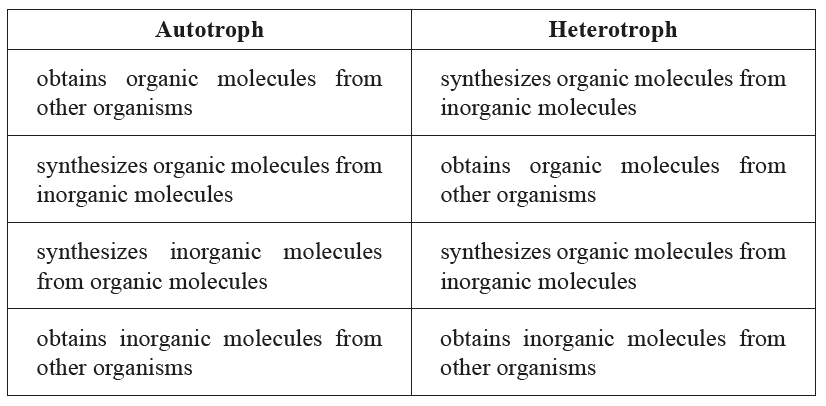
Which pair of statements is correct?
(IB 2013/NOV – SL 1/19C)
What are examples of greenhouse gases?
A. Ethane and ozone
B. Methane and nitrogen
C. Methane and carbon dioxide
D. Ethane and oxygen
2013 – NOVEMBER – HL
4.2 (IB 2013/NOV – HL 1/B)
4.4 (IB 2013/NOV – HL 1/C)
(IB 2013/NOV – HL 1/D)
2012 – NOVEMBER – SL
(IB 2012/NOV – SL 1/19B)
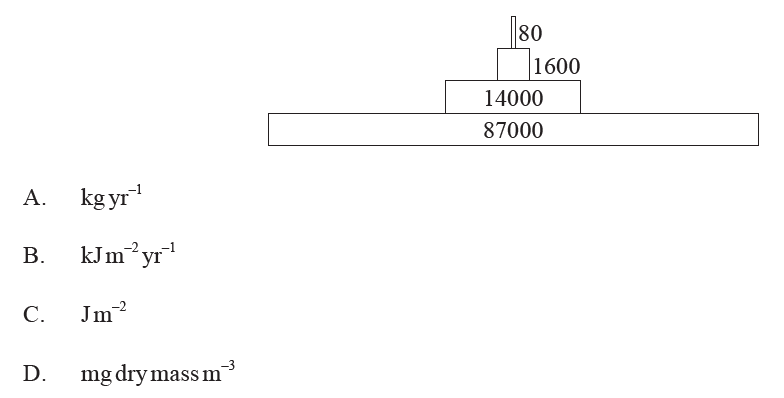
The diagram shows a pyramid of energy for a wetland environment. What units would be appropriate for the values shown?
(IB 2012/NOV – SL 1/20B)
The diagram shows the carbon cycle. Which letter indicates respiration?
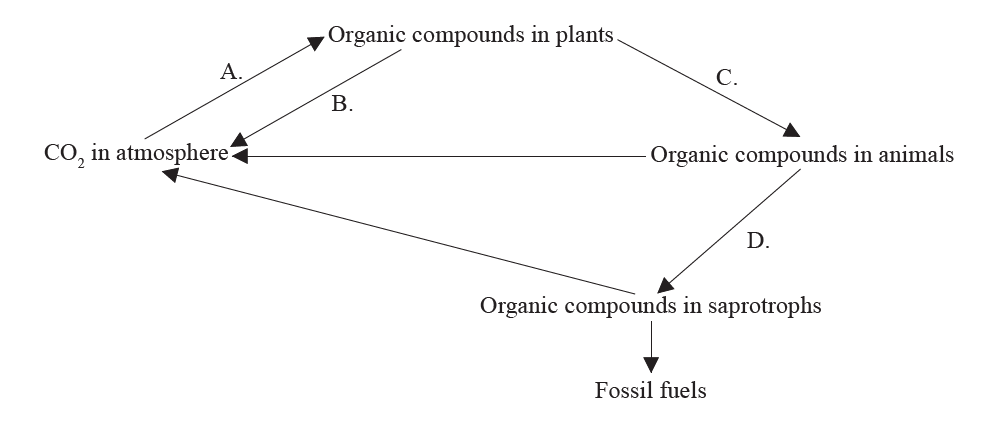
(IB 2012/NOV – SL 1/21A)
Which numbers represent exponential growth in a population of water fleas introduced to a new culture medium?
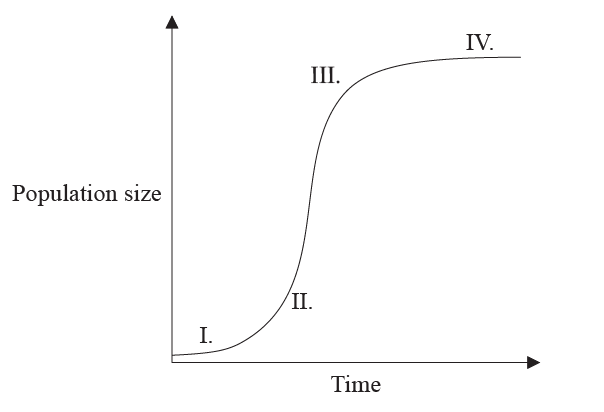
A. I and II
B. II and III
C. I, II and III
D. II, III and IV
(IB 2012/NOV – SL 1/22C)
Questions 22 and 23 refer to the following diagram which is part of a food web for a freshwater habitat
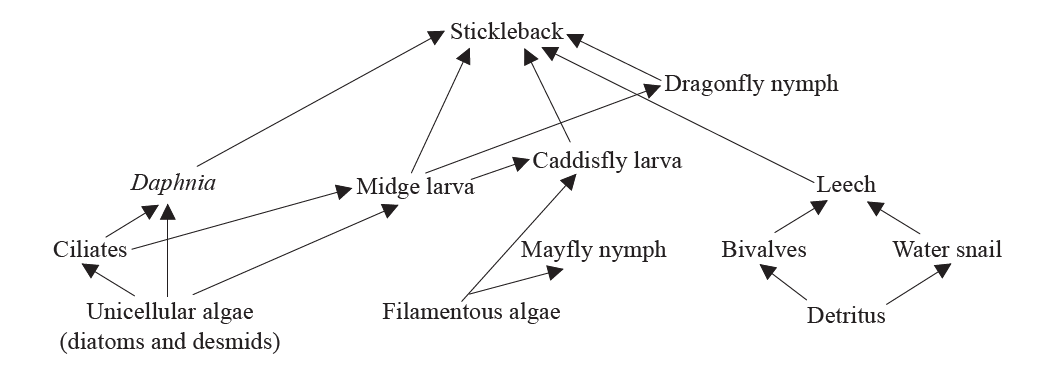
What is the mode of nutrition of midge larva?
A. Autotroph
B. Detritivore
C. Heterotroph
D. Saprotroph
(IB 2012/NOV – SL 1/23C)
Questions 22 and 23 refer to the following diagram which is part of a food web for a freshwater habitat
Which represents a correct food chain from this web?
A. stickleback → midge larva → unicellular algae
B. ciliates → Daphnia → stickleback → dragonfly nymph
C. diatom → midge larva → caddisfly larva → stickleback
D. filamentous algae → mayfly nymph → leech → stickleback
2012 – MAY – SL
(IB 2012/MAY – SL 1/18D)
In a pond, two species of fish feed on insects and worms. The insects feed on the green plants that live in the water. What constitutes a population in this ecosystem?
A. All the living organisms
B. All the animals
C. All the fish
D. All the fish of one species
(IB 2012/MAY – SL 1/19B)
What is recycled in an ecosystem?
A. Nitrogen, carbon and energy are all recycled.
B. Nitrogen and carbon are recycled but not energy.
C. Nitrogen is recycled but not carbon or energy.
D. Nitrogen, carbon and energy are not recycled
(IB 2012/MAY – SL 1/20D)
In a population of rabbits studied over a period of six months, it was found that natality was greater than mortality and emigration was greater than immigration. What can be concluded about the final population of rabbits?
A. It will have increased.
B. It will have decreased.
C. It will be exactly the same.
D. There is not enough information to make a valid conclusion.
2011 – MAY – SL
(IB 2011/MAY – SL 1/20B)
Which of the following is the best definition of a population?
A. A group of individuals that can interbreed and produce fertile offspring
B. The number of individuals of the same species in a given area
C. A group of species living and interacting with each other in a given area
D. The total number of individuals in a given area
(IB 2011/MAY – SL 1/21B)
The diagram below shows a simplified food web.
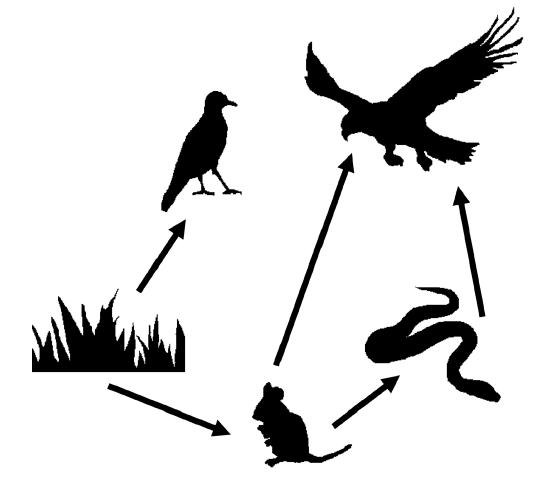
What is the role of the snake in this food web?
A. Primary consumer
B. Secondary consumer
C. Tertiary consumer
D. Producer
2011 – NOV – SL
(IB 2011/NOV – SL 1/20C)
Which of the following trophic groups include fungi?
A. Detritivores
B. Autotrophs
C. Saprotrophs
D. Producers
(IB 2011/NOV – SL 1/21B)
Which term best defines a group of populations living and interacting with each other in an area?
A. Ecology
B. Community
C. Species
D. Ecosystem
(IB 2011/NOV – SL 1/22A)
Which of the following statements relates to the precautionary principle?
A. Those responsible for an action that may be catastrophic must prove that it will not harm before proceeding.
B. Politicians have been warned by scientists about the impacts of global warming on ocean levels.
C. Rich countries must help less fortunate countries to build structures that will reduce the impact of higher ocean levels due to global warming.
D. Those who are concerned about an action that may be catastrophic must prove that it will do harm in order to stop the action from taking place.