2015 – MAY – SL
(IB 2015/MAY – SL P1/C)
What are homologous structures in animals?
A. Body parts in different animals produced by the same gene
B. Structures that have a similar function but a different origin
C. A modifi cation of the same structure in different animals
D. Structures found as part of the fossil record
2014 – NOVEMBER
(IB 2014/NOV – SL P1/C)
Which comparable features provide evidence for evolution?
A. The rear legs of a kangaroo and a grasshopper.
B. The wings of a myna bird and a butterfly.
C. The forearms of a human and fins of a whale.
D. The fur of a bear and a wolf.
2014 – MAY
(IB 2014/MAY – SL P1/A)
What term describes similar structures found in animals with a common ancestry?
A. Homologous
B. Inherent
C. Characteristic
D. Analogous
2013 – NOVEMBER – HL
(IB 2013/NOV – HL P1/B)
What is accepted by scientists as evidence for evolution?
I. Similarities in bone structure between the wings of a bat and the fins of a porpoise
II. Changes in dog breeds caused by artificial selection
III. Extinction of dinosaurs
A. I only
B. I and II only
C. I and III only
D. I, II and III
2013 – MAY
(IB 2013/MAY – SL P1/22C)
The long-term exposure of bacteria to antibiotics has led to the spread of resistant strains (for example, of Clostridium difficile). What is this an example of?
A. Convergent evolution
B. Immunity
C. Natural selection
D. Dominance
2012 – MAY
(IB 2012/MAY – SL P1/21A)
What characteristics describe homologous structures?
A. They have the same ancestral origin but may have different functions.
B. They have the same ancestral origin and always have the same function.
C. They have different ancestral origins and may have different functions.
D. They have different ancestral origins but always have the same function.
(IB 2012/MAY – SL P1/22D)
The Atlantic cod (Gadus callarias) is a fish which lays about 5 000 000 eggs in its lifetime. On average, only two of these eggs survive to become adult cod. How does this promote evolution?
A. All offspring are genetically identical, so become better adapted.
B. Laying many eggs provides food for other species to survive and become better adapted.
C. Some young cod change to become adapted to the environment and survive and pass on their genes.
D. Offspring with favourable variations survive and pass on their genes.
(IB 2012/MAY – SL P1/23A)
Based on binomial nomenclature, which two species are most closely related?
I. Common barberry (Berberis vulgaris)
II. Canadian bunchberry (Cornus canadensis)
III. Smooth blackberry (Rubus canadensis)
IV. Canadian barberry (Berberis canadensis)
A. I and IV
B. II and III
C. II and IV
D. III and IV
2011 – NOV
(IB 2011/NOV – SL P1/24D)
The following diagrams (not to scale) represent the fossilized forelimbs of three horses living at different times, none of which are alive today.
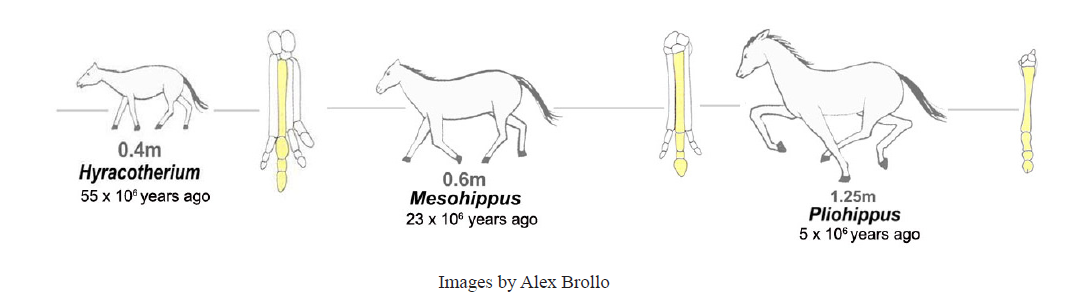
The diagrams provide evidence for which of the following?
A. Pentadactyl limb
B. Domestication of animals
C. Homologous structures
D. Change in the characteristics of species
2011 – MAY
(IB 2011/MAY – SL P1/23B)
What is evolution?
A A measure of the relative survival and reproductive success of an individual
B. A cumulative change in the genetically controlled characteristics of a population
C. A physical change during an organism’s life that is inherited by its offspring
D. A random change in the proportions of alleles from generation to generation
(IB 2011/MAY – SL P1/24B)
Two different trees have been classified as Pinus pinea and Pinus nigra. Which of the following statements is correct?
A. Both trees belong to the same class but a different genus.
B. Both trees belong to the same family and same genus.
C. The species name of both trees is Pinus.
D. The family names are pinea and nigra.
2010 – NOV
(IB 2010/NOV – SL P1/21C)
Which of the following will promote variation in a species?
I. Meiosis
II. Fertilization
III. Natural selection
A. I only
B. II only
C. I and II only
D. I, II and III
(IB 2010/NOV – SL P1/22D)
Why has antibiotic resistance evolved in bacteria?
A. All bacteria reproduce very quickly.
B. Bacteria exposed to antibiotics developed a resistance to them.
C. Varieties of bacteria resistant to antibiotics reproduce faster than non-resistant varieties.
D. Bacteria showing resistance to antibiotics survive after antibiotics are used.
(IB 2010/NOV – SL P1/23B)
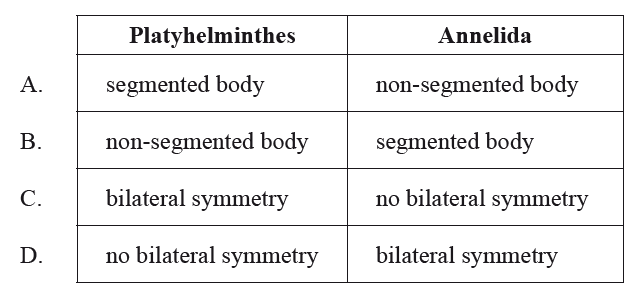
What features distinguish Platyhelminthes from Annelida?